- WeekendInvesting
- Posts
- ALERT!! How Sensex is at its Lowest Level ?
ALERT!! How Sensex is at its Lowest Level ?
The Geometry of the Crash

WeekendInvesting Analytics
April 16, 2026

Market Update - Thursday, 16 Apr
Morgan Stanley recently shared an update in their strategy playbook on the 8th of April, noting that Indian equities are currently sitting at a rare confluence of worst trailing returns, rough valuations, and rising earnings. Historically, this specific setup has not lasted very long.
Looking at where the market charts are headed, please read the disclaimer fully before moving forward. The Nifty chart is looking absolutely good. After almost nine sessions from the bottom, there has been a recovery of more than 10%. It would be no surprise to see the index lock itself in the region of 24,800 to 26,000 in the coming weeks. The key decision then will be whether the Nifty breaks out or consolidates further.
Meanwhile, Nifty Junior has made a V-shaped recovery. Despite poor news throughout March leading to a decline, just two weeks of April have brought it back to where it was.
All momentum trends on Nifty Junior have turned positive, up 1.07% for the day. Mid-caps also rose 0.63%, with all trends turning positive.
Small caps are up 0.92%, and crossing 16,400 could trigger another bout of bullishness.
Nifty Bank was the only soft index today, down 0.38%, though consolidation is expected after a recent run-up.
Gold remains very flat at 0.13%, while crude oil is trading near $95 and $96. A narrative is building that crude may not return to the $60 level.
This is partly due to damaged refinery capacities in Iran and elsewhere, which could take years to restore.
Even if crude prices dip, refined products may remain difficult to obtain. An average ballpark of $80 to $90 may persist, which would make inflation a worry for the world since crude oil is a primary input for most activities.
Consequently, dreams of reducing interest rates and low oil prices seem unlikely to be realized anytime soon.

Other Market Triggers
The heatmap was a mixed bag, with Adani and metal stocks doing well while banking stocks, led by HDFC Bank, lagged.
Notable gainers included Eternal, Hindalco, Adani Ports, and Adani Enterprise.
In the Nifty Next heatmap, PFC, Adani Power, Adani Green, Varun Beverages, HAL, Divi's Lab, Hyundai, Hindustan Zinc, and Vedanta performed well, while others saw profit booking.
In the mover of the day segment, GMDC surged 20% to a 52-week high, marking a complete breakout after six months of consolidation.
FSL jumped 11%, having been up as much as 18% during the day, potentially signaling a bottom for the stock.
U.S. Market Updates
In the US Markets, the previous session saw Tesla move up 7.5%, ServiceNow 7.2%, and Microsoft, Intuit, and Palantir moving between 4% and 6%. The Dow Jones was mildly down, but the S&P 500 rose 0.8%, the Nasdaq was bullish at 1.4%, and the Russell index was up 0.3%. Some of these stocks are part of the Weekend Investing US stock strategy.
The Nasdaq 100 heatmap looks strong with Microsoft, Apple, Palantir, Tesla, Avgo, and Nvidia performing well.
What to watch next ?
A tweet from Global Markets at Weekend Investing highlighted that the S&P 500 has seen a classic V-shaped recovery and is at an all-time high.
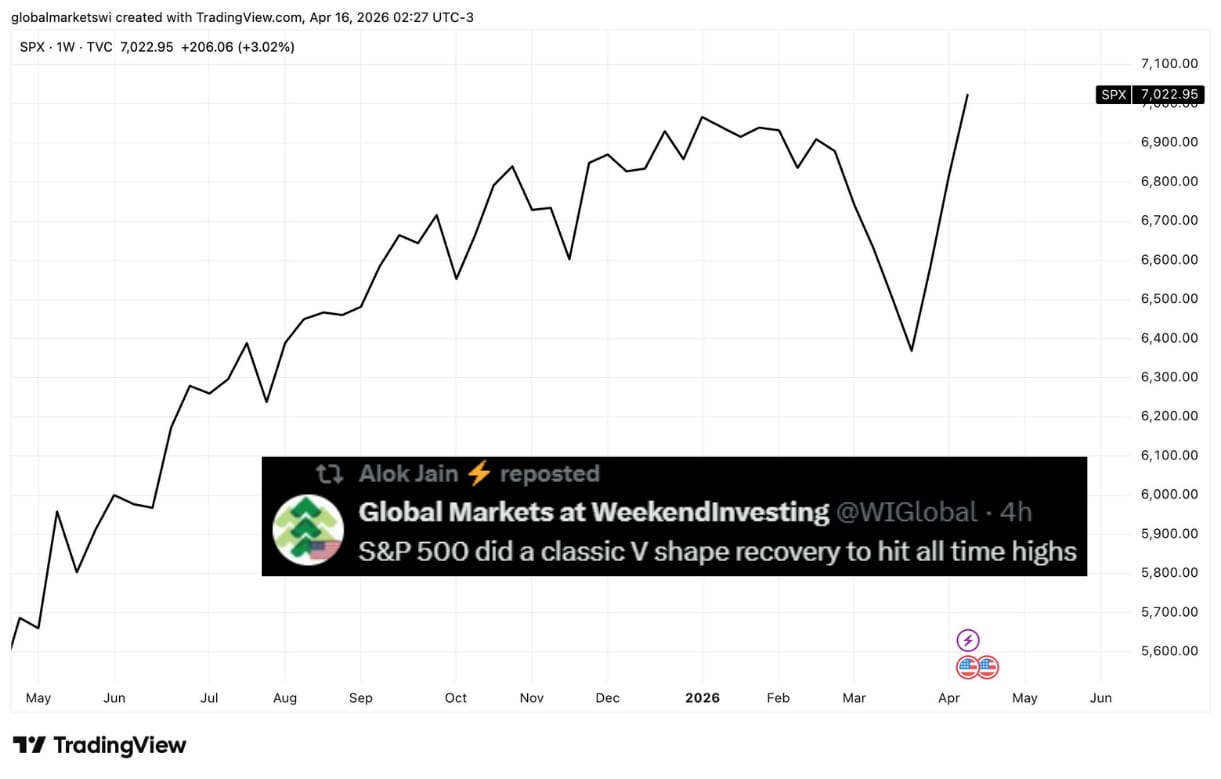
There is no reason to believe other markets won't follow. It is time to shed the pessimistic view and look at the market more optimistically.
Even countries involved in conflicts are hitting new highs, so we should not be too bogged down by external worries when the market is telling a different story.

Get your Portfolio Momentum Report today and ensure your investments are positioned for success!

Forwarded this email? Subscribe Now
Top Trending Strategies
Mi EverGreenPower of Gold with Equity | Allocate 20 strongest CNX200 stocks with Gold ETF | Monthly Rebalanced Mi Evergreen is a dynamic strategy which aims to outperform the underlying benchmark CNX200. This index comprises 200 large and mid-cap names which are the top-quality stocks in the markets. This product is suitable for use in all stages of the market cycles as it is designed to invest in the strongest stocks in the pack at any point. Additionally, there is a permanent hedge of Gold available here.
| Mi AllCap GOLDA core strategy to allocate 25% each to Large Cap , Mid Caps, Small Caps & Gold Mi AllCap GOLD is a robust, rule-based core rotational strategy from the House of WeekendInvesting, curated to cover stocks in the CNX500 universe, designed to offer a balanced asset allocation and diversified wealth creation approach for compounding returns over long periods of time.
|


The Geometry of the Crash: Why Market Dips are Your Greatest Opportunity
Market volatility often feels like a storm we need to hide from. But what if the data showed that these "storms" are actually the fuel for future wealth? Drawing from historical S&P 500 data presented by Ben Carlson, let's look at the frequency of market drawdowns over the last 98 years and, more importantly, what happens after the dust settles.
The History of the Fall: How Often Does It Happen?
Market corrections are not bugs; they are features of the financial system. Over the nearly past century, the S&P 500 has seen various levels of "drawdowns" (falls from peak prices). Understanding the frequency helps remove the "shock" when they occur:

Source : Ben Carlson
The Silver Lining: Returns After the Correction
While a falling market causes nervousness, the recovery stats are incredibly optimistic. If you look at the 5-year average returns following these dips, the "Win Rate" is nearly 98%.

Source : Ben Carlson
After a 10% fall: Average 5-year return is 72%.
After a 20% fall: Average 5-year return is 74%.
After a 30% fall: Average 5-year return climbs to 88%.
The math is simple: The deeper the correction, the higher the eventual spring-back.
The Trap of Static Portfolios
The biggest fear for an investor isn't just "Will the market recover?" but "Will my stocks recover?" In a traditional static portfolio, you might be heavily invested in sectors that lead the previous bull run but remain stagnant in the next one. If your selection is rigid, you might miss the recovery entirely while the rest of the market soars.
The Solution: The Self-Repairing Portfolio
To combat the uncertainty of which sector will lead the next rally, you need an Active Selection Strategy, specifically Momentum Investing.
Instead of hoping your current stocks perform, a momentum-based approach automatically shifts capital toward sectors showing strength.
Exit Weakness: It systematically removes stocks that are underperforming.
Enter Strength: It enters sectors that catch the first wave of the new rally.
Self-Repair: This creates a "Self-Repairing Portfolio" that evolves with the market trend, keeping you in an optimistic and positive financial position.
Meme Of The Day

Context: Historical data shows that after a 30% market correction, the average 5-year return is 88% with a 98% win rate. Knowing this, how does your strategy change when the market turns red? |
|

Share this daily insightful newsletter with your market savvy friends and family or sign them up for the newsletter !
For detailed blogs, reports and strategies, check WeekendInvesting.com
Reply